
Content
Joint Commission of the Federal and States Governments (Bund-Länder Commission)
The judiciary can look back on a long tradition of cooperation in the field of information technology. This development began in 1969 with the establishment of the “Bund-Länder-Kommission für Datenverarbeitung und Rationalisierung in der Justiz” (BLK – the Federal-State Commission for Data Processing and Rationalisation in the Judiciary) by the Conference of Ministers of Justice.
With the founding of the E-Justice Council in 2012, this cooperation was placed on a new footing. Since then, the BLK has continued to carry out its tasks as a standing working group within the E-Justice Council under the name “Bund-Länder-Kommission für Informationstechnik in der Justiz”(Federal-State Commission for Information Technology in the Judiciary). Since then, the E-Justice Council and the BLK have continued to evolve through the establishment of numerous working groups and development consortia.
The current work of these bodies focuses on the modernisation of key IT processes and specialist applications, the expansion of shared infrastructure — in particular the establishment of a nationwide Judicial cloud — and the introduction of AI systems within the judiciary.
The ongoing professional communication and exchange, as well as the close and trusting cooperation between the Länder and with the federal government, are essential prerequisites for the swift and successful digitalisation of the judiciary. They are accordingly of central importance for an efficient administration of justice and the further strengthening of our nation of laws.
Dr. Martin Wachter
Head of Division at the Bavarian State Ministry of Justice,
Department for Digitalisation and Innovation,
Chair of the Federal-State Commission for Information Technology in the Judiciary (BLK)
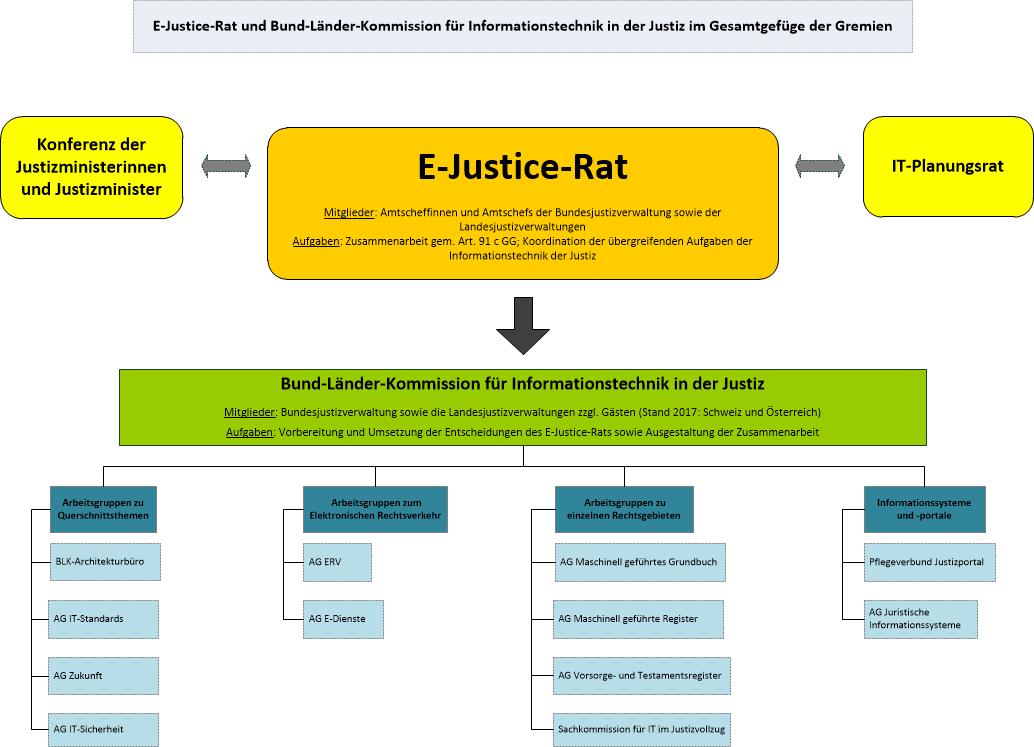
E-Justice-Rat und Bund-Länder-Kommission für Informationstechnik in der Justiz im Gesamtgefüge der Gremien
© Landesjustizverwaltung Nordrhein-Westfalen